Nuc or Package? How to Choose Your First Bees

You've bought your hive. You've got your veil and gloves. Now comes the part every beginner dreads: actually ordering bees. And almost immediately, you run into two options — a nucleus colony (a "nuc") or a package of bees. The difference matters far more than most suppliers will tell you.
Both will fill your hive with bees. But they arrive differently, get established differently, and carry very different levels of risk for a new beekeeper. The right choice depends on your goals, your budget, your timing, and — honestly — how much you trust your own ability to troubleshoot a struggling hive in the first critical weeks.
Let's break both options down so you can make an informed choice before you spend a single dollar.
What you're actually buying
Option A — The Nucleus Colony (Nuc)
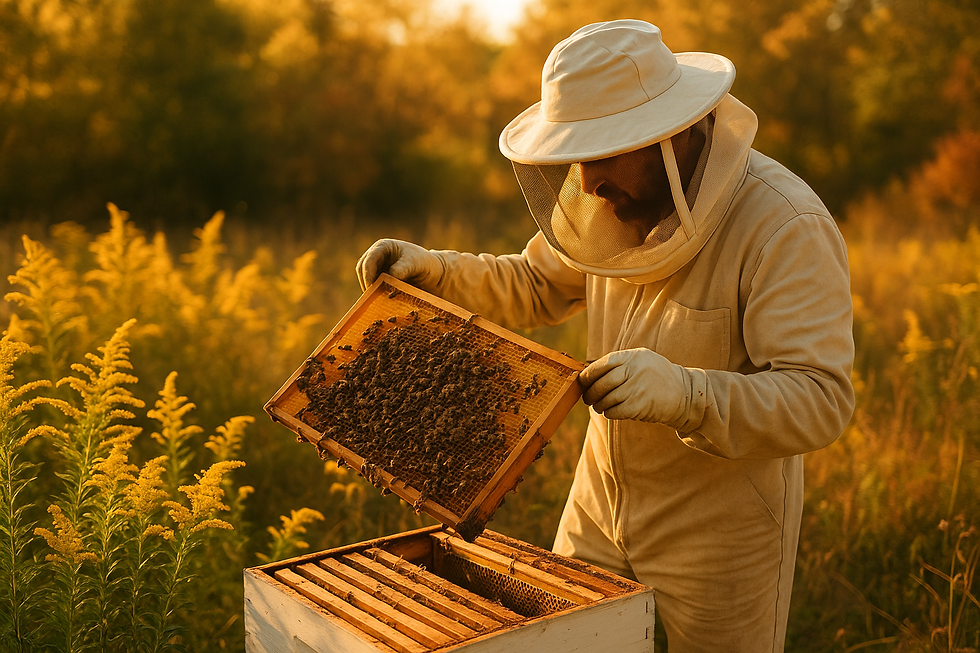
A nuc is a small, fully functioning colony — typically 4 or 5 frames of bees — that contains a laying queen, existing brood (eggs, larvae, and capped pupae) at various stages of development, stored honey and pollen, and thousands of worker bees. It arrives in a small cardboard or wooden box and is transferred frame-by-frame directly into your hive. Critically, the queen is already accepted and actively laying. The colony is already a going concern.
Option B — The Package of Bees
A package is a screened wooden or mesh box containing roughly 3 pounds of bees (about 10,000 workers) and a separately caged queen. The bees and queen in a package are strangers to one another — they were combined at the supplier's facility, often from different source colonies. There is no comb, no brood, and no stored food. The workers must first accept the new queen before she can begin laying, and your hive must be built from nothing.
The real difference: a head start vs. a blank slate
Think of a nuc as hiring a team that has already worked together. Think of a package as assembling a team from scratch, with a new manager the workers haven't met yet. Both can succeed, but the nuc removes several early-season risks that catch beginners off guard.
With a nuc, on day one you have brood at all stages, which means new bees are already emerging within a week of installation. The population never dips. With a package, there is a "population gap" — a 3–4 week period where no new bees emerge, the existing workers age out, and colony strength actually drops before it recovers. In a cold spring or during a nectar dearth, that dip can be catastrophic.
Nucleus Colony — what you get
Laying queen already accepted
Brood at all stages present
Drawn comb included (huge time saver)
Honey and pollen stores carried over
No population gap after installation
Higher price ($150–$250+ typical)
Local availability only; shorter season window
Package of Bees — what you get
Queen is caged and must be released by the workers
No brood — must start from eggs
No comb — workers must build it from scratch
No stores — must be fed immediately and consistently
Population dip lasts 3–5 weeks after installation
Queen acceptance can fail (5–15% risk)
Lower price ($130–$180 typical)
Ships nationwide; more broadly available
Timing: when you can get them
Packages are available earlier in the year — often starting in late February or March in warmer climates — and can be shipped by mail from suppliers in the South. This makes them appealing if you missed the local nuc window or are in an area where nucs aren't produced locally.
Nucs are typically available in spring and early summer, but only from local or regional beekeepers. They can't be safely shipped by mail because they contain open comb. You almost always need to pick one up in person.
Timing tip: In most of the northern United States, nucs become available between late April and early June. Reserve yours well in advance — local beekeepers often sell out by February or March. If you're reading this in summer, start asking now for next spring's supply.
How each option unfolds week by week
Week 0 — Installation day
Nuc: frames transferred directly, bees begin orienting immediately. Package: bees are poured in, queen cage is suspended between frames, supplemental feeding begins.
Weeks 1–2 — Queen acceptance period
Nuc: queen is already laying — just confirm she's still there and producing. Package: monitor the queen cage, check for queen release, watch for signs of rejection before your first full inspection.
Weeks 3–4 — The population gap
Nuc: new bees are already emerging from the brood you installed. Colony is growing. Package: the worker bees from installation are aging and dying with none yet emerging from new brood. Colony strength is at its lowest.
Weeks 5–6 — Recovery and growth
Nuc: well established, may be expanding to a second hive body. Package: new bees begin emerging, population starts climbing, comb-building begins in earnest.
Week 8+ — Main nectar flow
A nuc installed in early spring has a meaningful chance at a honey harvest in year one. A package installed at the same time usually focuses all its energy on building up — a surplus is unlikely in year one.
The queen problem
Of all the ways a package can go wrong for a new beekeeper, queen acceptance failure is the most common and the most confusing. When you install a package, the workers and the caged queen are strangers. The queen is separated from the colony by a candy plug — the idea is that by the time the workers eat through the candy and release her, they've been exposed to her pheromones long enough to accept her. Usually this works. Sometimes it doesn't.
A rejected or failed queen means a queenless colony, and a queenless colony is not something a beginner will necessarily recognize in time. Signs are subtle: no eggs after day 21, worker bees starting to lay (small scattered brood pattern, multiple eggs per cell), or a colony that seems inexplicably calm and reduced. By the time most new beekeepers figure out what happened, they're weeks behind and in need of an emergency queen.
Warning: Never release a package queen manually unless you're certain of what you're doing. If she emerges before the colony is ready to accept her, they will ball her — clustering around her in a tight mass until she overheats and dies. Let the candy plug do its job.
With a nuc, this whole chapter of anxiety doesn't exist. The queen has been laying and accepted for weeks or months. You verify her presence at installation, confirm the brood pattern looks healthy, and move on.
Cost: is the nuc worth the extra money?
A nuc typically costs $30–$80 more than a comparable package. For most beginners, it's worth every penny — but let's be honest about what you're paying for.
You're paying for drawn comb. New beekeepers almost universally underestimate how much energy a colony spends building wax comb from scratch. The bees in a package must consume roughly eight pounds of honey to produce one pound of wax. Drawn comb, already built and ready for use, represents weeks of labor that your colony doesn't have to perform. It lets the queen start laying immediately at full capacity.
You're paying for brood. A nuc with three frames of capped brood means thousands of new bees emerging in the first week. That continuous population input is what keeps the colony strong through spring.
You're paying for reduced risk. If you invest $300–$500 in a complete hive setup, the additional $50 for a nuc over a package is cheap insurance on that investment.
Worth knowing: If you're installing a package into brand-new undrawn frames, consider adding one or two frames of drawn comb from an established beekeeper friend or local club. Even a single frame of empty drawn comb gives the queen somewhere to start laying immediately and dramatically improves early establishment.
When a package makes sense
Packages aren't a bad choice — they're the right choice in specific situations.
You can't find a local nuc supplier, or they've already sold out for the season. Package suppliers ship nationwide and often have more availability.
You need bees early in the season and you're comfortable with the higher-maintenance first few weeks.
You're repopulating a hive that already has drawn comb from a previous colony. With existing comb in the hive, the biggest disadvantage of a package disappears entirely.
You're an experienced beekeeper comfortable monitoring and troubleshooting queen issues. A package in skilled hands is a routine operation.
Quick decision guide
Choose a nuc if...
This is your first or second hive
A local beekeeper sells nucs nearby
Your hive has no drawn comb
You want a shot at honey in year one
You prefer a lower-risk first season
You can pick up late April through June
Choose a package if...
No local nuc suppliers are available
You have existing drawn comb in your hive
You need bees early in the season
You're comfortable with close monitoring in the first three weeks
You're replacing a deadout hive with drawn comb already in place
Budget is a genuine constraint
One more thing: ask about the queen
Regardless of which option you choose, ask your supplier about the queen's lineage and age. A nuc with a two-year-old queen who's about to supersede is not the head start you're looking for. A good nuc should have a young, vigorous queen — ideally less than one year old — with a solid brood pattern (mostly solid, capped, dome-shaped worker brood with few empty cells).
Ask local beekeepers, your county extension office, or your nearest beekeeping club to recommend reputable suppliers. A well-sourced nuc from a local beekeeper who breeds for hygienic traits, gentleness, and productivity is worth far more than a cheaper nuc from an unknown source.
The premium option: overwintered nucs
If a spring nuc is a head start, an overwintered nuc is a running start. These are nucleus colonies that were established the previous summer or fall, successfully survived an entire winter, and are available for sale in early spring — often before standard nucs are even ready.
An overwintered nuc has proven itself. It didn't just get started; it lived through months of cold, cluster stress, and depleted stores and came out the other side with a healthy, tested queen and a population ready to explode the moment temperatures rise. When you transfer an overwintered nuc into a full hive in late March or April, you're not starting from a nuc — you're starting from a colony that's already in spring buildup mode.
Why overwintered nucs are exceptional for beginners
Standard nucs installed in May still need 4–6 weeks to fill out a full hive body. An overwintered nuc installed in early April can be filling a second hive body by late May. That lead time matters enormously in climates with a short, concentrated nectar flow. In the Mid-Atlantic and Northeast, for example, the main flow from tulip poplar and black locust happens in a roughly 4–6 week window in May and June. A colony that enters that window strong and populous will make honey; one still building population will not.
Beekeeper's edge: Many experienced beekeepers consider overwintered nucs the single best way to start a new hive, precisely because the survival filter has already been applied. You know the queen is productive, the bees are robust, and the genetics are suited to your local climate — all before you spend a cent on additional equipment.
There are real trade-offs to know about. Overwintered nucs are scarcer than spring nucs. Beekeepers who produce them take on the full risk and cost of wintering an extra colony. Expect to pay $50–$100 more than a standard spring nuc, typically in the $200–$350 range. And because supply is genuinely limited, you'll need to reserve yours in late fall or early winter — beekeepers who offer them often take a waitlist and sell out before the new year.
There's also an installation nuance: an overwintered nuc in early spring may already be close to swarming. The colony has been in a small box all winter and is eager to expand. When you transfer it, do so on a mild day, inspect carefully for swarm cells, and have your full hive set up and ready. The bees may fill it faster than you expect.
Overwintered Nuc vs. Standard Spring Nuc — at a glance
Overwintered Nuc
Queen has survived a full winter — proven genetics
Available 4–6 weeks before standard spring nucs
Strong buildup coincides with main nectar flow
Best realistic chance of a year-one honey harvest
Locally proven genetics, adapted to your climate
Higher cost ($200–$350+ typical)
Reserve by November–December or earlier
Monitor carefully for swarm impulse at installation
Standard Spring Nuc
Queen established but not winter-tested
Available May–June in northern climates
Builds population steadily through spring and summer
Honey harvest possible in year one but less likely
Genetics may or may not be locally adapted
Moderate cost ($150–$250 typical)
Reserve by January–March
Lower swarm pressure at installation
If you can find a reputable local beekeeper who offers overwintered nucs, put your name on the list now — regardless of what time of year you're reading this. The window to reserve them is short. Your local beekeeping association is the best place to find who offers them in your area.
"The bees you start with set the tone for everything that follows. Spend a little more, start a little stronger, and give yourself the gift of a first season you actually enjoy."
Beekeeping has a steep enough learning curve without stacking the odds against yourself in the first eight weeks. For most new beekeepers in most parts of the country, a well-sourced nucleus colony from a local beekeeper is the single best investment you can make at the start of the journey.
Order early, ask questions, and enjoy the extraordinary thing you're about to get into.


Comments